
Basement Flooring
Best Flooring for Kansas City Basements Starts With Moisture Testing
Choose basement flooring by testing moisture, checking the slab and drainage history, then matching exact product instructions to the room’s use.
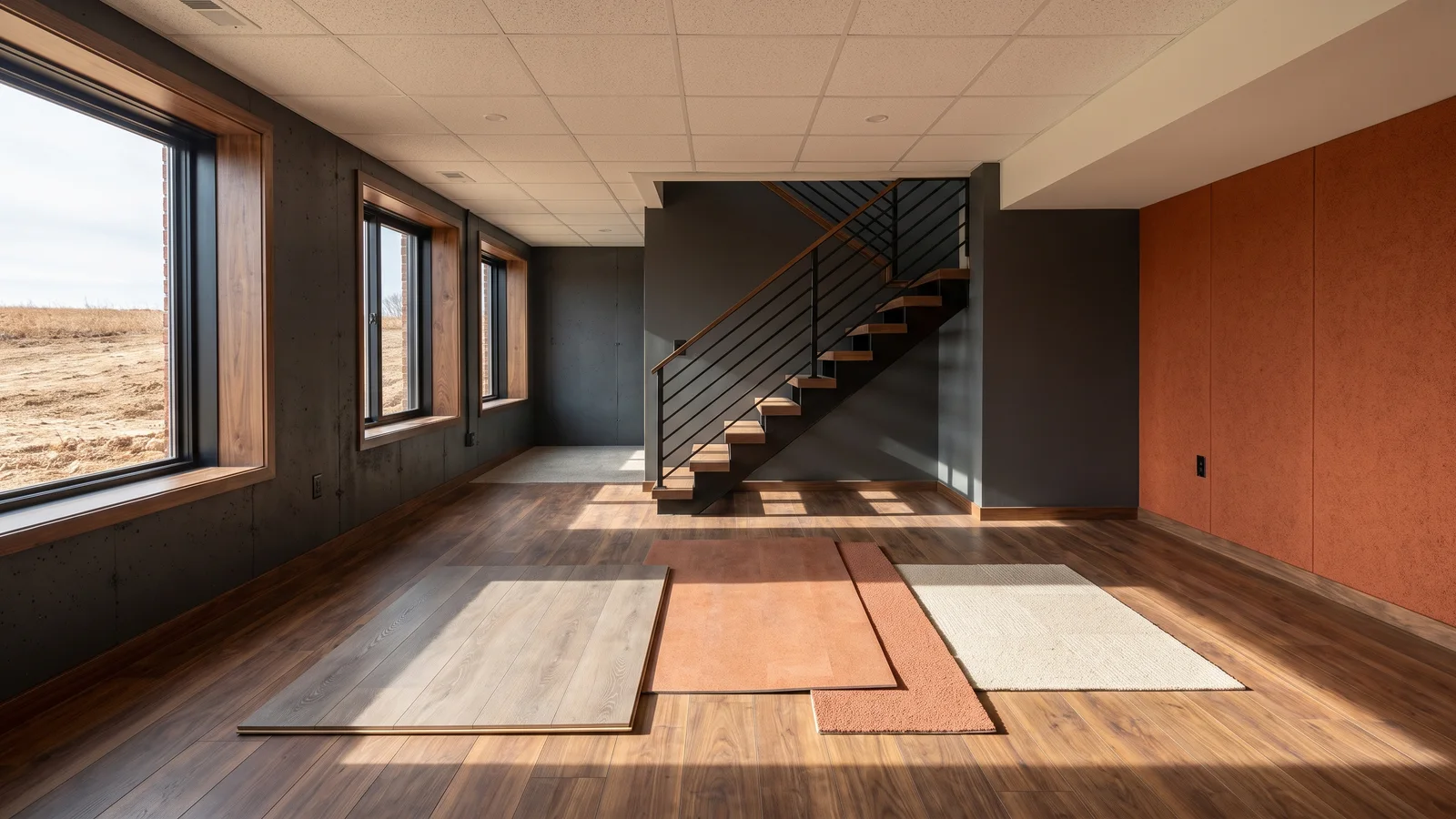
Direct answer
The best basement floor is an exact product whose installation instructions match measured slab and room conditions, moisture history, grade level, and intended use. Moisture testing and correction of active water sources come before choosing hardwood, engineered wood, LVP, laminate, tile, or carpet.
Treat moisture as a decision gate
A basement can look dry on inspection day and still have vapor movement, seasonal humidity, plumbing risk, wall seepage, drainage problems, or a history of water entry. Stains and odor are clues, not measurements. Before selecting flooring, identify active sources and use the testing method required by the proposed product, adhesive, underlayment, or mitigation system.
Flooring cannot repair the building envelope. Gutters, grading, foundation conditions, sump operation, plumbing, and interior humidity may require attention outside the flooring scope. Covering an unresolved problem can trap moisture, damage the product or substrate, and delay discovery. A responsible recommendation separates water-source correction from the floor assembly.
- Document past seepage, plumbing events, and sump operation.
- Check whether the slab has coatings, cracks, adhesive, or contamination.
- Use the test method and limits named by the exact product system.
- Resolve active moisture sources before installation.
- Retest when conditions or mitigation work require confirmation.
Compare products only after the site is understood
Engineered wood may be approved for some below-grade applications, but approval depends on its instructions, installation method, and substrate conditions. Solid wood is not automatically interchangeable with engineered construction. LVP, laminate, tile, and carpet also vary by product; category labels alone do not establish suitability for every basement.
A waterproof marketing word should not be interpreted as a waterproof room. Water can move at perimeters, seams, penetrations, walls, and underneath a surface. The substrate, adhesive, underlayment, base details, and response to a leak remain relevant. Read the full technical and warranty documents, including limits for standing water, floods, moisture emissions, and installation below grade.
| Option | Questions to resolve |
|---|---|
| Engineered hardwood | Below-grade approval, method, moisture limits, renewal expectations |
| LVP | Subfloor limits, vapor control, seam and perimeter details, flood exclusions |
| Laminate | Below-grade approval, core exposure limits, underlayment, spill response |
| Tile | Slab cracks, movement, membrane, grout, surface temperature |
| Carpet | Moisture history, cushion, adhesive, cleanup, replacement plan |
Match the assembly to how the basement is used
A guest room, playroom, home gym, laundry area, workshop, and entertainment space place different demands on a floor. Consider rolling loads, exercise equipment, soft-surface needs, pet cleanup, sound, thermal comfort, sunlight at walkout doors, and access to drains or utilities. An attractive sample can still be a poor operational match.
Think about the consequence of a future water event. Some assemblies may allow easier local removal, drying, inspection, or replacement than others, but no outcome is guaranteed. Continuous flooring under built-ins can complicate access. Keeping labeled spare material may help with future repair, although pattern changes and discontinued products can still prevent an invisible match.
Use product documents as the installation rule
The Lowe’s-hosted manufacturer laminate guide cited below illustrates the level of detail a real instruction document can contain: substrate preparation, moisture testing, grade-level conditions, expansion space, room transitions, and environmental requirements. The specific values in one guide cannot be generalized to another brand or material. They show why the exact document matters.
The NWFA technical library likewise treats moisture and site conditions as measured installation concerns. Ask who performs each test, which standard or manufacturer method is used, how results are recorded, and what happens if a reading is outside limits. A verbal statement that the slab seems dry is not equivalent to documented compatibility.
Build a Kansas City basement plan from the actual home
Local weather can create large seasonal changes, but a Kansas City address does not predict one basement’s moisture performance. Age, drainage, foundation, soil relationship, mechanical systems, and maintenance differ from house to house. Site evidence is more useful than a citywide product ranking. The correct choice may also differ between rooms in the same lower level.
JAVE Hardwood Floors installs several flooring categories in Kansas City and communities within approximately 60 miles. A recommendation follows site review, measurements, intended use, and current manufacturer instructions. This guide does not claim that any category is universally waterproof or that flooring work alone can solve a basement water problem.
Frequently asked questions
- Is LVP always the best choice for a basement?
- No single category wins every basement. The exact LVP must be approved for the grade level, substrate, measured moisture conditions, underlayment or vapor requirements, and intended use. Water-resistant plank construction also does not correct seepage, protect every layer below, or guarantee recovery after flooding.
- Can engineered hardwood be installed below grade?
- Some engineered products permit certain below-grade installations, while others do not. Product construction, method, slab or subfloor, vapor control, environment, and measured conditions all matter. Check the exact manufacturer instructions and do not transfer an approval from one engineered product to another.
- What should happen if basement moisture readings are too high?
- Pause the flooring decision and identify the source and applicable limit. Building drainage, plumbing, humidity control, slab mitigation, or another correction may be needed. The response must be compatible with the selected assembly and verified as required before installation proceeds.
Sources
- NWFA: Technical Guidelines and Publications(accessed 2026-07-23)
- Lowe’s-hosted Manufacturer Laminate Installation Guide(accessed 2026-07-23)
Talk through your flooring project with JAVE
Share the service, ZIP code, and room details to start a project-specific estimate.